
Slopes, swales and channels
Erosion Control & Hydromulch in Dallas, TX
Holding bare clay and chalk slopes in place until grass takes over.
- No-cost site visit and a written quote
- Quotes split into prep, seed, mulch and erosion items
- Seed mix and timing planned for North Texas heat
Keeping Soil Where It Belongs
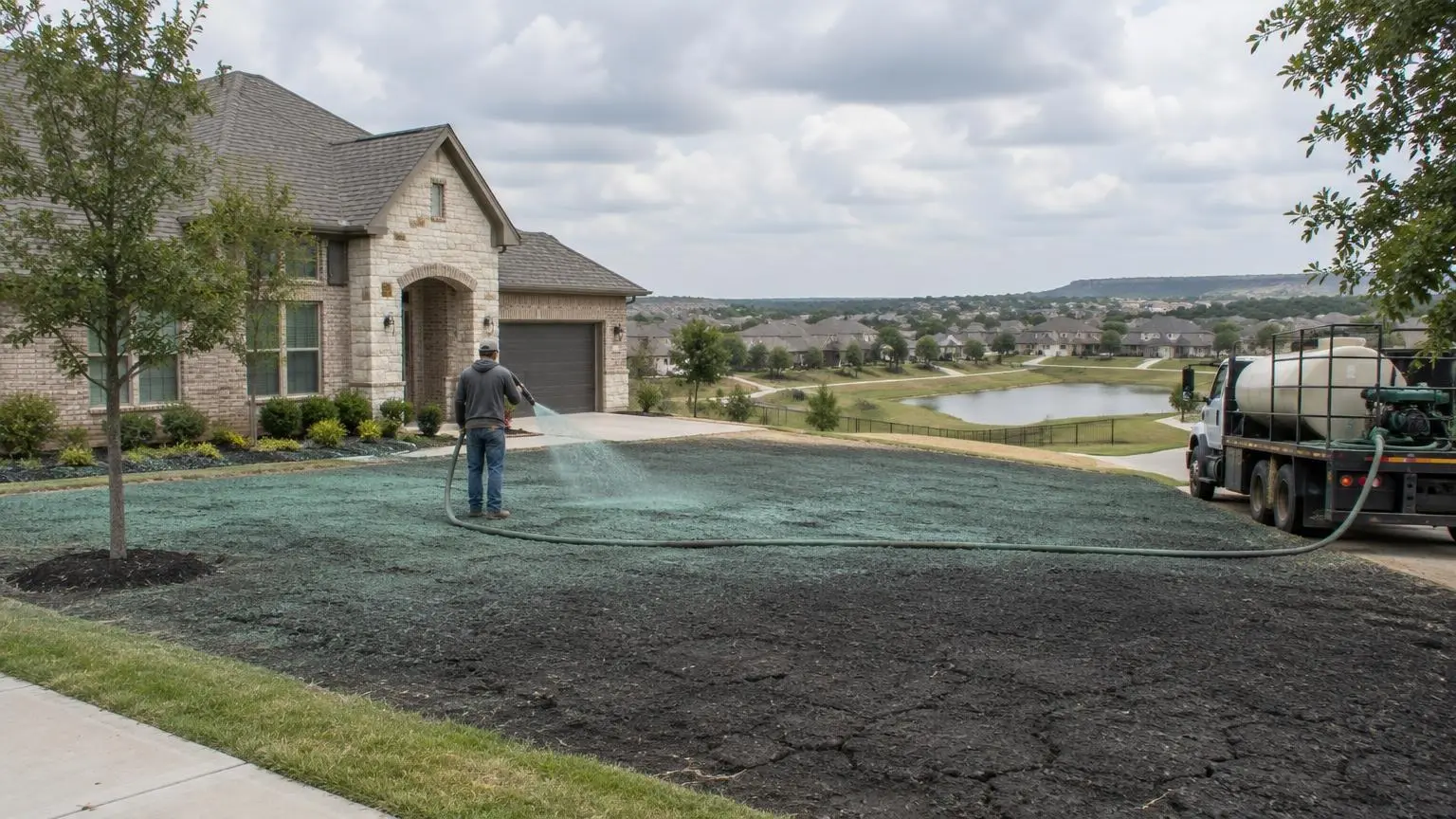
Erosion control and hydromulch work covers the ground in Dallas that plain seeding cannot hold by itself: steep backyard slopes, creek banks, drainage swales between houses, ditches along new roads and detention pond sides. We spray heavier mulch rates and bonded products, lay erosion control blankets where water concentrates, and pair both with seed so permanent vegetation takes over. Homeowners call us after a slope washes into the patio; builders and site contractors call because their stormwater plan needs disturbed ground stabilized.
Why Dallas soil washes
Blackland clay seems tough when it is dry and hard, but water erosion is one of the main soil management problems on the Texas Blackland Prairies. Dry clay cracks open, and the first heavy rain runs into those cracks and along the surface instead of soaking in. Runoff from spring storms, with cold fronts meeting Gulf moisture, can be intense. May and October average more rain than any other months. Bare slopes that look stable in August can lose inches of soil in a single afternoon in May.
Chalk slopes south of the Trinity
The White Rock Escarpment, the western edge of the Austin Chalk, rises about 230 feet and runs north to south through Dallas County. It is most obvious south of the Trinity River in Oak Cliff and in the neighboring cities of Cedar Hill, Grand Prairie and Irving. Western blackland areas often carry shallow soil over chalk. On those slopes there is little soil to hold seed, and water moves fast. We often combine topsoil, a bonded product and blankets on chalk slopes rather than relying on mulch alone.
Choosing the right cover
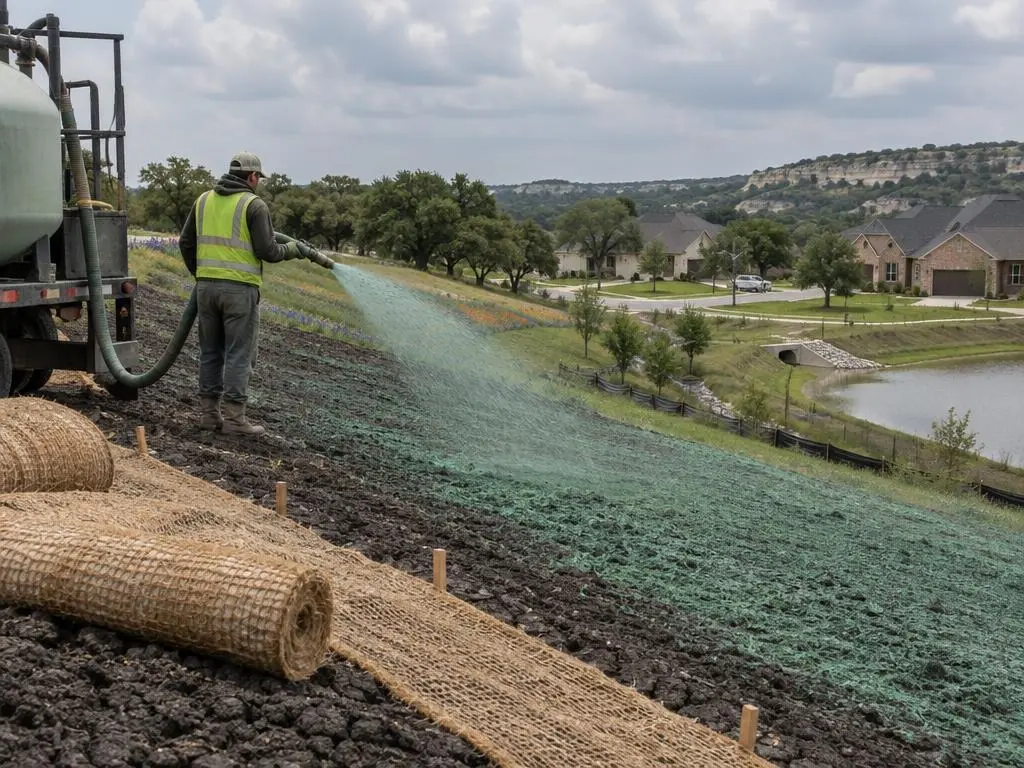
Standard hydromulch, a wood fiber slurry with tackifier, is fine on gentle grades. As slopes get steeper or longer, we move up to higher mulch rates and bonded fiber matrix, which binds the fibers into a crust-like layer that resists raindrop impact. Where water collects and flows, in swales, ditches and pond inlets, spray-on products are not enough, and erosion control blankets go down instead. Straw blankets suit short-term protection on moderate slopes; straw-coconut and coir blankets last longer for channels and steeper ground. Slope stabilization usually means mixing these by zone on the same site.
Seeding under the cover
Every treatment we install is meant to give grass time to root. On lawns that usually means Bermuda. On creek banks, pond sides and open areas, a native prairie mix with grasses like little bluestem, sideoats grama and switchgrass can make a longer-lived, lower-maintenance cover; those grasses grew naturally on Houston Black clay before the prairie was plowed. Out of season, we use mulch and temporary cover first and seed the permanent mix when soil warms.
On construction sites
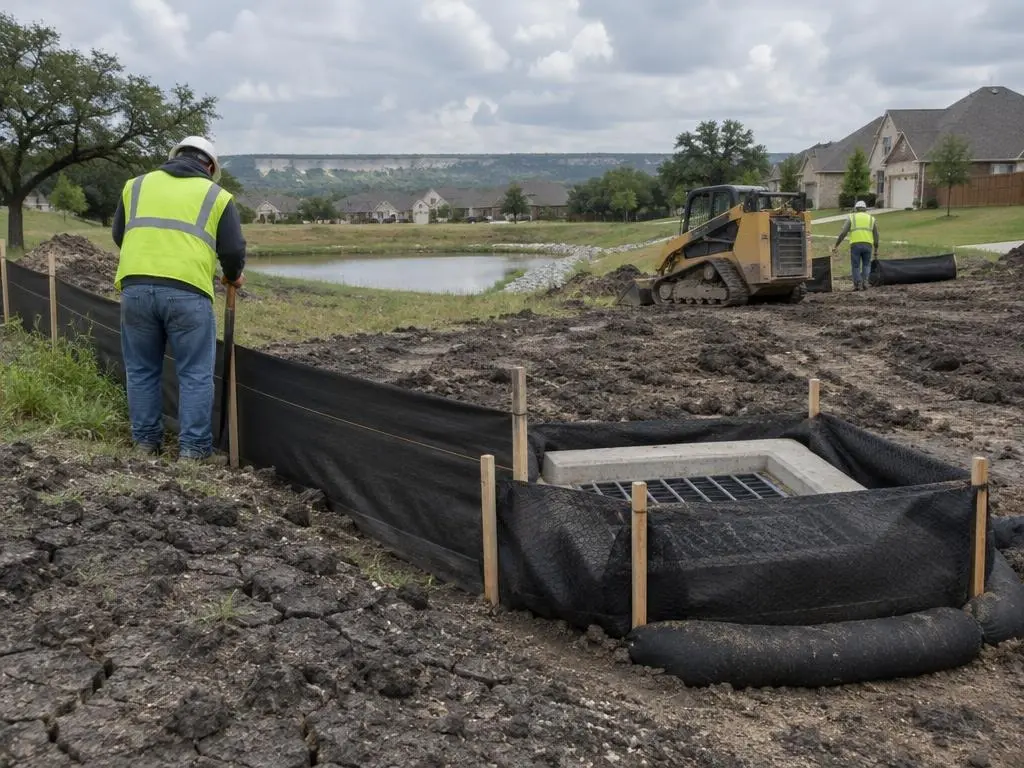
For projects under the TCEQ Construction General Permit, the stormwater plan lists the practices used to control erosion and how the site will be stabilized. We install blankets, hydromulch and seed to the plan, mark what we did by area, and come back for repairs after storms if your inspector flags a problem spot. As erosion control contractors, our role is the physical work; the plan and its inspections stay with the site operator.
Erosion control for homeowners
Most of our erosion control calls from homeowners start with a specific problem: a backyard that slopes down to a creek and loses soil every spring, a side yard where the downspouts and the neighbor's grade dump all the water into one strip, or a pool or retaining wall project that left a bare bank. These are smaller jobs than a construction site, but the principles are the same. Find out where the water comes from and where it wants to go, repair the grade, choose a cover that matches the slope and the flow, and get grass growing under it. Sometimes the right fix is partly drainage, such as extending a downspout or cutting a shallow swale, so the slope is not asked to handle more water than it can. We explain what each option does and roughly how long it should take for grass to take over, then put it all in a written quote. If a slope is steep or tall enough that it may need a retaining structure or an engineer's input, we say so instead of selling blankets that will not solve it.
What it costs
Current consumer price guides do not list blankets or bonded fiber matrix, so the reference in the table below comes from one state transportation department's 2025 unit prices for erosion work done under contract. No present-day public price for bonded fiber matrix turned up in our research, so that line is set once we measure the slope and decide on the product. For larger channels and pond banks on commercial or municipal sites, we can also break the price out by zone so the owner can see what the blankets, the bonded fiber and the seeding each cost, and decide where to spend more for long-term protection.
Erosion Control Options
Matched to slope, flow and how long protection must last.
Hydromulch with seed
Wood fiber mulch and tackifier for gentle grades and large flat areas.
Bonded fiber matrix
A bonded spray cover for steep or long slopes that need more hold.
Straw erosion control blankets
Straw blankets stapled over seed on moderate slopes.
Coir and straw-coir blankets
Longer-lasting blankets for channels, swales and steeper ground.
Swale and ditch lining
Blankets and seed in drainage paths that carry concentrated flow.
Native grass slope seeding
Prairie grass mixes for banks, ponds and areas that will not be mowed often.
Reference Rates for Erosion Work
| Item | Rate |
|---|---|
| Wood fiber hydromulch sprayed (2025 DOT erosion unit-price list) | $98 per 1,000 sq ft |
| Straw-coconut 70/30 blanket installed (same schedule) | $468 per 1,000 sq ft |
| Coir blanket installed (same schedule) | $532 per 1,000 sq ft |
| Dry straw mulch, hand sown (same schedule) | $170 per 1,000 sq ft |
| Residential slope add-on to hydroseeding (HomeGuide) | $0.05 to $0.10 extra per sq ft |
| Bonded fiber matrix | No current published price; quoted on site |
The schedule figures are 2025 public reference rates for contract work, not Dallas quotes. Slope length, flow and access change every job, and the amount on the quote you approve is what we charge.
From Washout to Stable Ground
1. Find the water
We trace where runoff enters, concentrates and leaves the slope.
2. Repair the grade
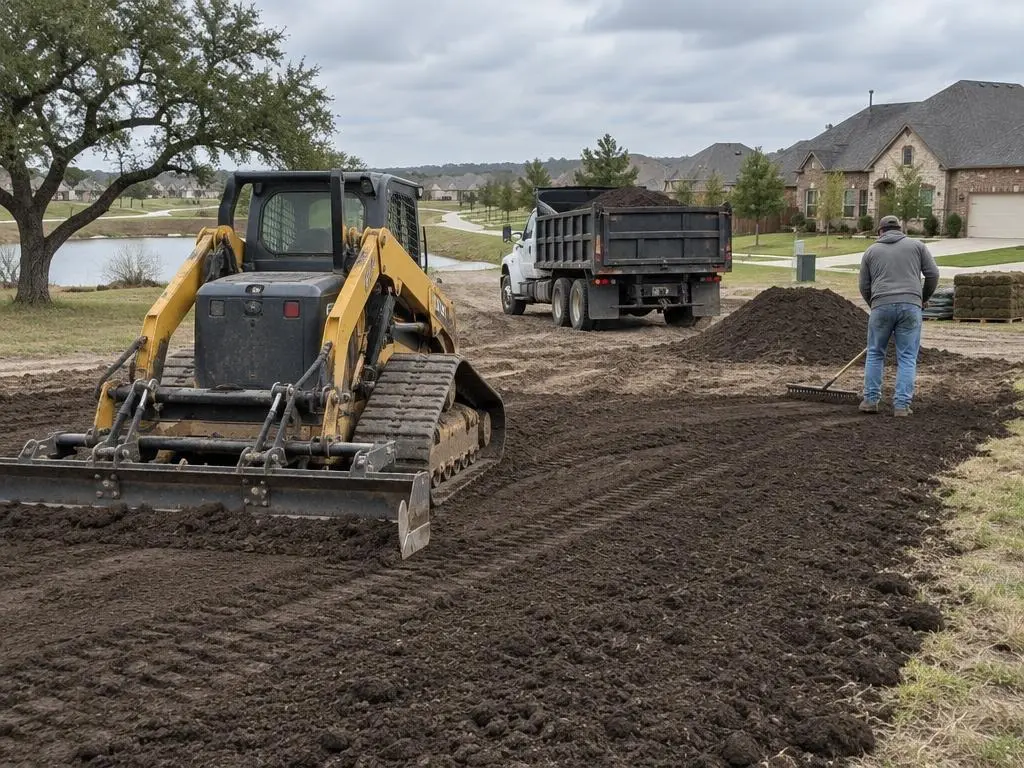
Fill rills and gullies, add topsoil on thin chalk or subsoil.
3. Seed and cover
Seed, then hydromulch, bonded fiber or blankets by zone.
4. Secure blankets
Trench the top edge and staple to pattern so water cannot get under.
5. Check after storms
We look at problem spots and repair washouts while grass establishes.
Why Choose Us for Erosion Control & Hydromulch
Zone-by-zone design
Mulch on the flats, blankets in the flow lines.
Chalk and clay experience
We plan for thin soil on escarpment slopes and cracking clay elsewhere.
Seed built in
Every cover is paired with a grass that will take over.
Erosion Control & Hydromulch Questions
Is hydromulch enough for my backyard slope?
On a gentle slope with no concentrated flow, often yes. Steeper or longer slopes, or anywhere water channels, usually need bonded fiber matrix or erosion control blankets.
What are straw blankets, and when do you use them?
They are mats of straw held in netting, laid over seed and stapled down. We use them on moderate slopes and short channels where hydromulch would wash.
Do erosion control services include the seed?
Ours do. The cover is temporary; the grass underneath is what holds the slope long term.
Can you fix a slope that keeps washing out every spring?
Usually, once we find where the water is coming from. Many repeat washouts start at a downspout, a fence line or a neighbor's grade, so the fix may include redirecting water before re-covering.
Erosion Control & Hydromulch Service Areas
- Hydroseeding in Dallas, TX
- Hydroseeding in Frisco, TX
- Hydroseeding in McKinney, TX
- Hydroseeding in Plano, TX
- Hydroseeding in Prosper, TX
- Hydroseeding in Celina, TX
- Hydroseeding in Rockwall, TX
- Hydroseeding in Allen, TX
- Hydroseeding in Garland, TX
- Hydroseeding in Rowlett, TX
- Hydroseeding in Wylie, TX
- Hydroseeding in Forney, TX
- Hydroseeding in Little Elm, TX
- Hydroseeding in Cedar Hill, TX
- Hydroseeding in Midlothian, TX
- Hydroseeding in Waxahachie, TX
- Hydroseeding in Mansfield, TX
- Hydroseeding in Grand Prairie, TX
- Hydroseeding in Flower Mound, TX
- Hydroseeding in Arlington, TX
- Hydroseeding in Mesquite, TX
- Hydroseeding in Lewisville, TX
- Hydroseeding in Denton, TX
Get an Erosion Control & Hydromulch Estimate
Send photos of the slope or washout to start.